Yala National Park has one of the highest leopard densities of any protected area on earth. This is not marketing language; it is the finding of researchers who have spent seasons in this landscape with camera traps and patience. The park’s Block 1, which is the section most visitors enter and the section closest to the coast, is home to a leopard population that in density exceeds almost any other wild leopard habitat globally.
And yet: on a given morning drive, you may not see one.
This is worth sitting with.
What the numbers mean and don’t mean
High density in leopard terms is a relative phrase. Leopards are solitary, territorial, and fundamentally secretive animals. Their evolutionary success is built around concealment. A leopard that has lived for years in a landscape has calibrated its relationship to that landscape with extraordinary precision: it knows where the shade falls in the midday heat, which rocks hold warmth at night, which routes allow it to move without being seen. It has also calibrated its relationship to the jeep, which it has observed since it was a cub.
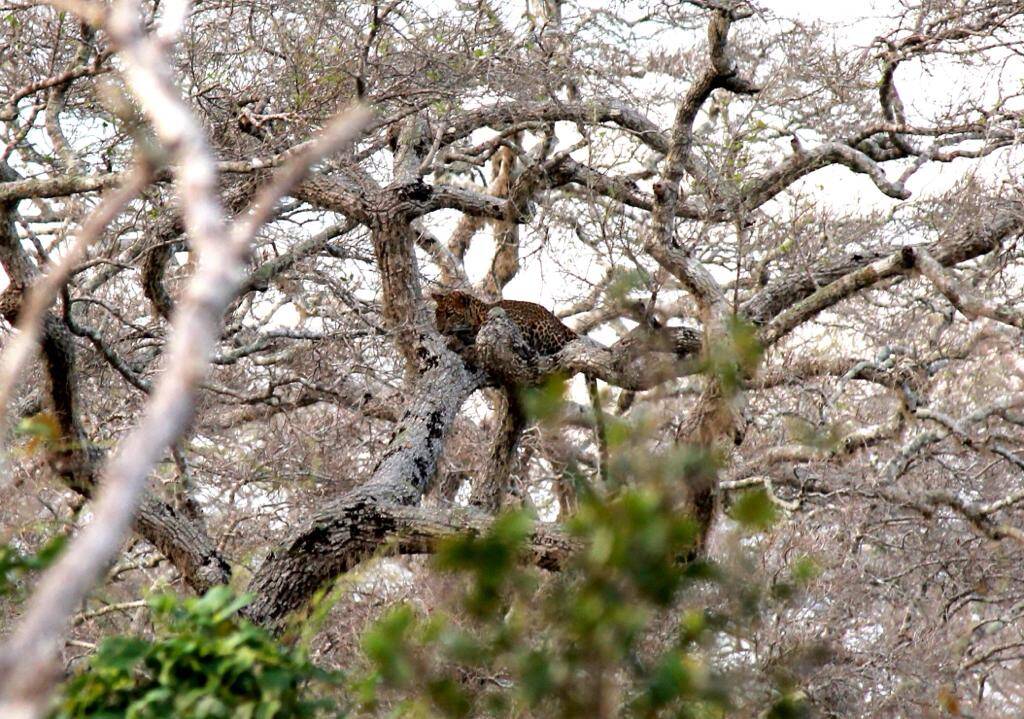
This calibration is what produces what guides call “a sighting.” Not the leopard revealing itself, but the leopard allowing you to see what was already there.
When a morning passes without a sighting, the leopards are not absent. They are simply not choosing to be visible. This is a distinction that seems philosophical but is in fact quite practical: the same animal that ignored your jeep at 6 a.m. may appear at the same spot at 6:05 a.m. the following morning, because the light has shifted by three minutes and the shadow it was using has moved.
The park that contains them
Yala Block 1 is not a large territory by the standards of a wide-ranging predator. Elephants, deer, bears: all of these animals move across the landscape in patterns a first-time visitor can begin to anticipate after a few drives. The leopards move more narrowly and more cryptically. Each resident animal has a home range it patrols and defends with a level of sophistication that the researchers with their camera trap networks spend months mapping.
What this means for visitors is that the park’s leopards are not evenly distributed across the landscape. They are where they are for specific reasons: prey availability, access to water, territorial boundaries with neighbouring animals. A guide who has worked these blocks for years has an intuition about where these animals are likely to be on a given morning that amounts to something close to reading the landscape as the leopard does.
This knowledge is not transferable over a single trip. It accumulates across seasons.
Absence as information
There is a way of receiving a drive on which the leopard does not appear that is defeat, and there is a way of receiving it that is education. The experienced guides who work this park tend toward the second.
A dry tank that was full the previous week tells you something about the pace of the dry season. A stretch of scrub with no birds calls in it tells you something has passed through recently. The direction the spotted deer are looking tells you something about what they can smell that you cannot. None of this appears in the photographs from the morning, but it is a form of reading the park that a person who has been in it several times begins, slowly, to develop.
An empty waterhole tells you the least and the most, depending on how closely you look. To an untrained eye passing by, it is simply empty: nothing worth the frame. But a waterhole with a wet trail leading away from it into the thicket is a different kind of empty. That trail is usually left by bathing animals, water buffalo most often, spooked mid-wallow and driven out fast enough to leave the ground churned and dark behind them. It can mean a leopard came through only moments ago. It can just as easily mean one is on its way in to drink. Either way, the waterhole that looks abandoned is often the busiest part of the park you will not see.
The leopards we don’t see are part of the park in the same sense as the ones we do. They are somewhere in the scrub and the rock outcrops. They are resting. They are watching. Their absence from the road is not their absence from the landscape.
What conservation actually means here
The presence of leopards in Yala at this density is not an accident. It is the consequence of decades of protection (imperfect protection, interrupted at times, contested at others) but protection nonetheless. The park’s boundary is a line that has been defended, for the most part, against the pressures that have reduced leopard populations elsewhere in Asia: habitat loss, prey depletion, human-wildlife conflict.
Yala is a refuge in the literal sense: a place the animals can be, generation after generation.
To visit and not see a leopard is to encounter the same question that conservation puts to all of us: what does it mean to protect something you cannot always see? The answer is that absence is not emptiness. A park with leopards you don’t see is better than a park with no leopards to miss.
We think the arithmetic is worth it. Come for several mornings. Stay patient.
The park is full.