

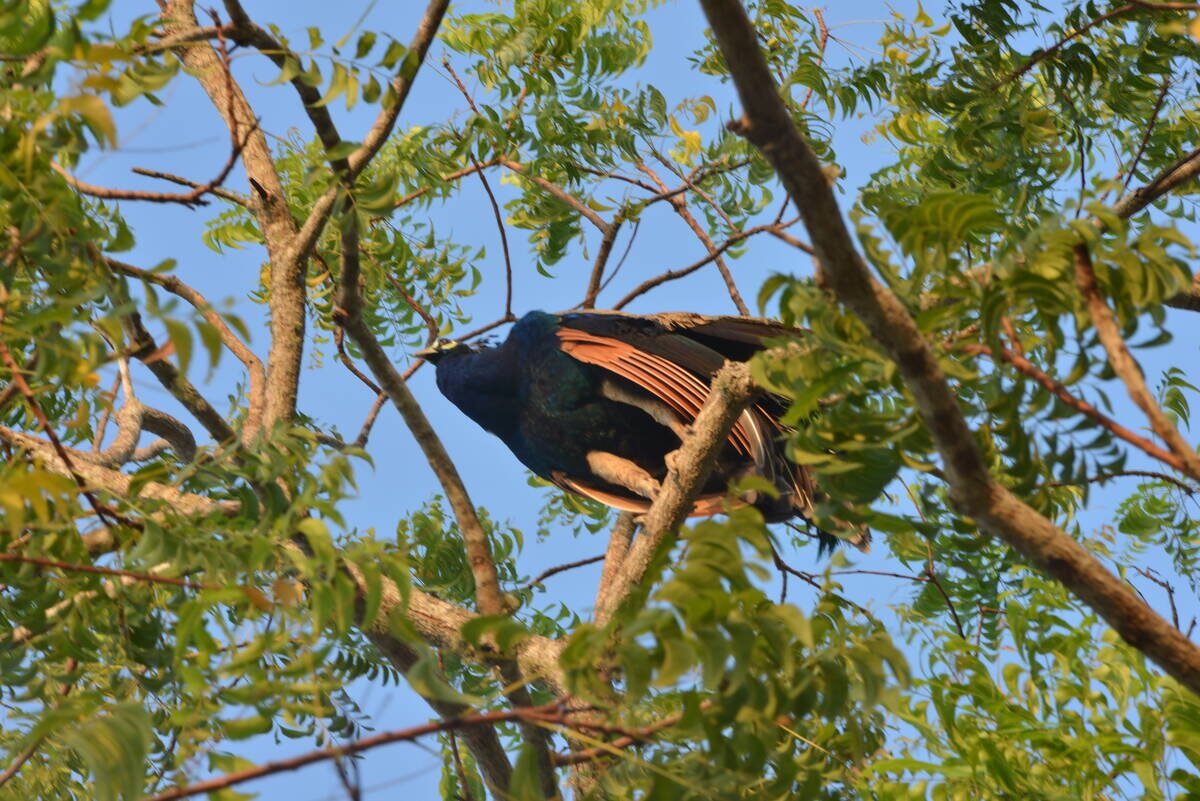
There is a neem tree on the eastern side of the property, near the garden wall, that George considers his. We have not told him this (peacocks do not take instruction well) but he has arrived at this understanding through daily practice, which is perhaps the more durable kind of knowing.
George is Arana’s resident peacock. He came with the garden, or perhaps he came before the garden, in the way that certain animals arrive in a place and make it theirs before anyone has thought to extend an invitation. By the time the family noticed that there was a peacock who appeared each morning and climbed to the same high branch of the same neem tree, he had already been doing it long enough to have established precedent.
The ritual
He arrives, most mornings, some time after the first light but before the heat has set in. He does not rush. Peacocks in a garden move with the particular unhurried deliberateness of animals that have decided they are not prey, and George has clearly made this decision.
The neem tree is not the tallest tree in the garden, but it has a branch at an elevation that suits him: high enough to survey the grounds, shaded enough to be comfortable in the late morning, positioned so that he can see the pool on one side and the lane beyond the garden wall on the other. He climbs it with a series of hops that he seems faintly annoyed to have to perform. Once settled, he becomes still.
He is, in the mornings, an excellent ornament.
The second visit
Most guests only ever see him in the morning, and reasonably assume that is the whole of him. It is not. In the late afternoon, as the day lets go of its heat, George climbs the same neem a second time. He watches the gold on the rooftops of the deluxe wing go soft, then grey, with the same unhurried attention he gives the pool at sunrise.
He does not stay for the dark. Sometime before the light goes, so does he.
What he looks at
Peacocks (the Indian peafowl, Pavo cristatus, which is what George is) are not endemic to Sri Lanka, but they have been part of this landscape long enough that the distinction barely matters here: woven into the temple grounds, the gardens, the roadsides of the south, alongside the Sri Lankan junglefowl, the island’s own endemic bird. At Yala National Park, peacocks appear on drives with enough frequency that first-time visitors, sighting one in full display, briefly confuse the experience with seeing something more exotic.
George does not display for the garden. He is, as best we can tell, uninterested in the opinions of people standing near the pool with their phones pointed at him. His tail, which in display would be a performance of considerable splendour, remains folded. He is here to sit in his tree, not to be photographed sitting in his tree.
This seems to us a reasonable position.
What he represents
We are careful here about what we claim. The large animals of Yala (leopards, elephants, bears) are in the park, twelve kilometres away, reachable on a morning drive. They are not in this garden. George is what this garden has.
But George is not nothing. A peacock who returns each morning to the same tree in the same property is a small argument for stillness: for the idea that a place becomes known to its animals, and that knowing takes time, and that the accumulation of mornings has its own value. He has been climbing this tree for longer than any individual guest has been staying here.
He will be climbing it when they are gone.
The neem tree itself
The neem tree (Azadirachta indica) is not particularly celebrated in the iconography of safari lodges. It is not the acacia of East Africa, with its silhouetted umbrella crown against an orange sky. It is a working tree: bitter leaves, pale flowers, medicinal properties documented across centuries of Ayurvedic use. The Sinhala name, kohomba, appears in Buddhist literature. It grows quickly, provides shade efficiently, and does not seem to care what uses it is put to.
The bush dinners happen under the neem trees, in the garden and by the pool. The tables are long and low-lit, and if you are seated in the right chair at the right time of evening, you can see the branch where George spent his morning.
He will not be there by dinner. He has his schedule, and it does not include the hours after dusk.
But the tree holds his shape in the mind, the way a place holds the shape of what moves through it.
We think that is enough.